Article
⚠️ Simplifying Business Risk Assessment: An Innovative Proposal
Business risk assessment is essential but often complicated by excessive granularity. This post proposes a simplified approach using a 2x2 matrix to maintain effectiveness and clarity in risk management without sacrificing precision.
Risk assessment is often conducted using matrices like the classic 4x4 PxD (Probability x Damage), commonly used in health and safety risk evaluations. This matrix combines 4 levels of probability and 4 levels of impact to create a risk map with 16 combinations, which ultimately reduce to just 3 risk categories: low, medium, and high.
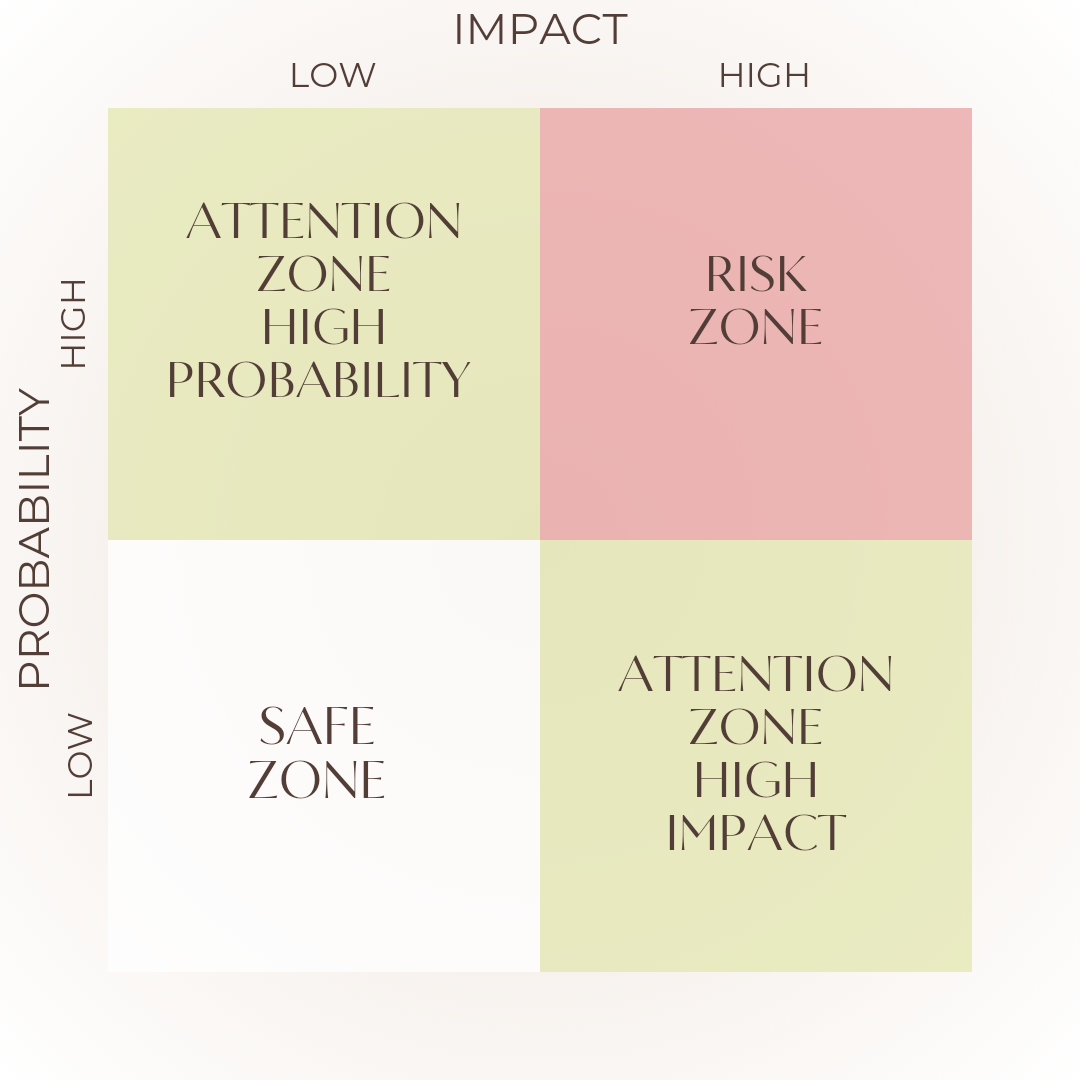
But if we end up reducing everything to 3 categories, why not simplify from the start? Let's imagine a 2x2 matrix that retains the essence of risk assessment while offering greater simplicity and clarity. Here’s how it could work:
1. Quadrant 1 - "Safe Zone" (low probability, low impact)
- Risk control actions: Regularly monitor to ensure that probability and impact remain low.
- Risk improvement actions: No additional actions needed.
2. Quadrant 2 - "Attention Zone: High Probability" (high probability, low impact)
- Example: A frequent business activity that, in case of issues, generates minimal consequences.
- Risk control actions: Ensure the impact remains low by managing the activity with care and constant monitoring.
- Risk improvement actions: Reduce the likelihood of adverse events through targeted interventions that decrease the frequency of issues, thus moving into the "Safe Zone."
3. Quadrant 3 - "Attention Zone: High Impact" (low probability, high impact)
- Example: A risk that, although unlikely, could have severe consequences for the company if it materializes.
- Risk control actions: Implement and maintain mitigation measures to reduce the potential impact, such as prevention strategies or emergency plans.
- Risk improvement actions: Reduce the impact at the source to move into the "Safe Zone."
4. Quadrant 4 - "Risk Zone" (high probability, high impact)
- Example: A significant risk that, with high probability, could cause severe damage to the company.
- Risk control actions: Immediately apply measures to reduce the likelihood of occurrence and adopt mitigation strategies to limit the impact.
- Risk improvement actions: Address the root cause to reduce both the likelihood of occurrence and the impact by revising business practices or adopting new technologies.
Rethinking Risk Assessment: A New Perspective with a 2x2 Matrix
1. Introduction
1.1 Context of Risk Assessment
Risk assessment is a crucial element in business management, especially when it comes to ensuring health, safety, and operational efficiency. Traditionally, the most commonly used model for risk assessment is the 4x4 matrix (Probability x Impact). This tool combines four levels of probability and four levels of impact, creating a risk map that, although detailed, results in significant complexity in its interpretation and operational management. The purpose of this matrix is to systematically identify, classify, and manage risks, but its complexity can sometimes hinder quick and precise decision-making.
1.2 Limitations of the Traditional Model
Despite the widespread use and recognition of the 4x4 matrix, it presents several practical limitations. One of the main criticisms is that, despite the division into 16 different combinations, risks are generally reduced to only three categories: low, medium, and high. This reduces the effectiveness of the initial assessment, making the complexity of the matrix somewhat redundant. Additionally, managing 16 different combinations can be burdensome, with the risk of diluting attention on critical issues and unnecessarily complicating the decision-making process.
1.3 Objective of the New Approach
To overcome these limitations, I propose an alternative model based on a 2x2 matrix. This new approach, simpler and more intuitive, reduces the number of possible combinations to four distinct quadrants, allowing for more direct and effective risk management. The objective of the 2x2 matrix is to retain the essence of risk assessment while offering greater operational clarity and a focus on the most necessary interventions.
2. The 2x2 Matrix: Structure and Quadrants
2.1 Structure of the 2x2 Matrix
The 2x2 matrix is structured according to two fundamental dimensions: probability and impact. Each dimension is divided into two levels: low and high. This simplification results in four distinct quadrants, each representing a specific combination of probability and impact:
- Safe Zone: Low probability, low impact.
- Attention Zone: High Probability: High probability, low impact.
- Attention Zone: High Impact: Low probability, high impact.
- Risk Zone: High probability, high impact.
2.2 Definition of Quadrants
-
Quadrant 1 - Safe Zone: This quadrant represents risks with low probability and low impact. These are considered minimal risks that require regular monitoring to ensure they remain under control.
-
Quadrant 2 - Attention Zone: High Probability: Here, we find risks that have a high probability of occurring but a relatively low impact. These risks, though not catastrophic, may occur frequently and require careful management to prevent them from escalating into more serious problems.
-
Quadrant 3 - Attention Zone: High Impact: This quadrant includes risks that, although unlikely, can have very serious consequences. Their management requires specific mitigation measures to reduce the potential impact while ensuring that the probability remains low.
-
Quadrant 4 - Risk Zone: Represents the most critical risks, those with high probability and high impact. These risks require immediate and decisive interventions to reduce both the probability and impact, as they can have devastating effects on the company.
2.3 Operational Flexibility of the 2x2 Matrix
A significant advantage of the 2x2 matrix over the 4x4 matrix is its operational flexibility. Simplification into four distinct quadrants not only facilitates the understanding and management of risks but also allows for targeted actions to move from one quadrant to another or to remain in a desired quadrant. For example, a risk located in the "Risk Zone" can be managed through interventions that reduce its probability, thereby shifting it towards the "Attention Zone: High Impact." Similarly, risks in the "Safe Zone" can be maintained through continuous monitoring and ongoing improvements in operational conditions. This dynamic approach makes the 2x2 matrix a tool not only for assessment but also for active risk management.
3. The Need for Action in Risk Management
3.1 Importance of Control and Improvement Actions
Once risks are identified through the 2x2 matrix, it becomes essential to implement concrete actions to manage them. Control actions aim to keep risks within acceptable limits, preventing them from worsening or turning into major problems. Improvement actions, on the other hand, are proactive interventions aimed at further reducing the probability or impact of risks, with the goal of moving them to less critical quadrants of the matrix.
3.2 Types of Actions Needed
The necessary actions can be divided into two main categories:
-
Control Actions: These include preventive and mitigative measures that keep risks stable and under control. For example, in a high probability and low impact risk, control actions focus on ensuring that the impact does not increase.
-
Improvement Actions: These actions aim to reduce the overall risk by lowering the likelihood of occurrence or the potential impact. An example might be the adoption of new technologies or the modification of business processes to reduce the impact of a high impact and low probability risk.
3.3 Timing and Prioritization of Actions
Not all risks require immediate intervention. The 2x2 matrix helps to establish priorities by identifying which risks require immediate actions and which can be monitored over the longer term. Risks in the "Risk Zone" demand absolute priority, with immediate and decisive interventions, while risks in the "Safe Zone" can be managed through continuous monitoring.
3.4 Actions to Move Between Quadrants or Stay in a Desired Quadrant
A key aspect of the 2x2 matrix is the ability to plan and execute specific actions to modify the position of a risk within the matrix. If a risk is currently in the "Risk Zone," actions should aim to reduce the probability and/or impact, moving it towards a less critical quadrant. Similarly, for risks in the "Safe Zone," it is essential to maintain the conditions that allow remaining in that quadrant, preventing the risk from slipping into a more dangerous zone. This maneuverability makes the 2x2 matrix a dynamic and highly efficient tool in risk management.
4. Risk Control Actions
4.1 Control in Quadrant 1 - Safe Zone
For risks placed in the "Safe Zone," control actions focus on maintaining the status quo. Regular monitoring and continuous verification of operational conditions are essential to ensure that neither the probability nor the impact increases. The adoption of a regular control system is crucial to prevent the risk from shifting to more dangerous quadrants.
4.2 Control in Quadrant 2 - Attention Zone: High Probability
In this quadrant, where probability is high but impact is low, control actions must be aimed at ensuring that the impact remains under control. This can be achieved through the rigorous application of standardized procedures, continuous monitoring, and careful management of operations to prevent escalations that could lead the risk to a higher impact.
4.3 Control in Quadrant 3 - Attention Zone: High Impact
For risks situated in the "Attention Zone: High Impact," control actions must focus on impact mitigation strategies. Although the probability of these risks is low, the severity of the consequences in case of occurrence requires proactive measures. These measures can include the preparation of emergency plans, the implementation of additional safety measures, and the training of staff to manage crisis situations. It is essential that the company is prepared to address these risks, minimizing the impact through preventive planning and rapid, effective response.
4.4 Control in Quadrant 4 - Risk Zone
The "Risk Zone" represents the highest level of danger, with risks that are both highly probable and highly impactful. In this quadrant, control actions must be immediate and decisive. The company must implement measures that quickly reduce the probability of occurrence, such as reviewing operational practices and adopting new mitigation technologies. At the same time, it is necessary to limit the potential impact through structural interventions, such as the introduction of backup systems, diversification of critical resources, and implementation of business continuity plans. The goal is to move the risk out of this critical zone as quickly as possible.
5. Risk Improvement Actions
5.1 Improvement in Quadrant 1 - Safe Zone
Although risks in the "Safe Zone" are considered minimal, there is no immediate need for additional actions. The primary focus in this quadrant is on maintaining the current state through regular monitoring to ensure that the risk remains low. While continuous improvement is always an option, no specific actions are required unless there is a significant change in the risk profile or operational environment.
5.2 Improvement in Quadrant 2 - Attention Zone: High Probability
In "Quadrant 2," the goal of improvement is to reduce the probability of risky events. This can be achieved through a series of interventions, such as optimizing business processes, introducing specific preventive measures, and training staff on better operational practices. Reducing the probability of occurrence allows the risk to shift towards the "Safe Zone," thereby reducing the need for constant and intensive monitoring.
5.3 Improvement in Quadrant 3 - Attention Zone: High Impact
In "Quadrant 3," improvement actions must focus on reducing the potential impact. This may include adopting new technologies that reduce the severity of consequences in the event of an incident, modifying operational procedures to minimize potential damage, or introducing compensatory measures that mitigate the effect of a risky event. The goal is to reduce the impact sufficiently to move the risk towards a less dangerous quadrant, ideally approaching the "Safe Zone."
5.4 Improvement in Quadrant 4 - Risk Zone
In the "Risk Zone," the goal of improvement actions is twofold: to reduce both the probability and the impact of the risk. This may require a deep review of business practices, the adoption of advanced risk mitigation technologies, and an organizational restructuring that enhances the overall resilience of the company. Interventions such as the implementation of early warning systems, the adoption of international safety standards, and the introduction of a more robust risk management system are essential to move the risk out of this critical zone. The ultimate goal is to minimize the possibility that a risk remains in this quadrant, gradually reducing it towards a safer zone.
6. Conclusion
6.1 Benefits of the 2x2 Model
The adoption of a 2x2 matrix for risk assessment offers numerous advantages over the traditional 4x4 model. The simplicity and operational clarity of the 2x2 matrix enable more effective risk management, allowing decision-makers to quickly identify the most concerning areas and implement concrete actions to manage risks. The flexibility of the 2x2 matrix also allows for the planning and execution of targeted strategies to move risks towards less critical quadrants or to maintain risks within acceptable limits.
6.2 Practical Implications for Companies
For companies, adopting the 2x2 matrix means having a more agile and intuitive tool for risk management. This approach facilitates internal communication about risks, making it clearer at all levels of the organization what actions are necessary and why. Furthermore, the ability to shift between quadrants or maintain a desired position allows companies to respond quickly to changes in the risk landscape, thereby improving their resilience and sustainability in the long term.